Saturday, March 04, 2017

A Painter with No Country: Portraits by George W Bush


I saw George W promoting his book of portraits of veterans on Jimmy Kimmel, and even though he works from photographs, which do more than half the work, I have to say that I like them. I like them a lot. They are fresh, lively, free spirited, colorful, imaginative, fluid, even fun, with a certain flair, and a very nice sense of timing and of the whole. He actually has a good eye.


I think it is hard for people to admit that. I tried writing about his portraits once before and had to pull it for political reasons. But that is wrong. Frankly as much grief as it will cost me, I like to keep politics out of art. I like to think that most of the time art is, if not above politics, separate.


I didn't vote for W, and although we are very distant cousins on my father's side and his mother's(somewhere I have a picture of the two of them together), I pretty much disagree with everything he stood for as president. But...I like his paintings. Go figure.


The irony is that his people can't appreciate his paintings, they are not about skill and show little, and my people can't ever forgive him or stomach him or see the paintings with unclouded eyes, so he is kind of a painter without a country. I saw Charlie Rose, who must have less aesthetic sensibility than a doorstop, belittle him about it, and he didn't get any love from Kimmel either. So no love for George and his paintings. Strange karma indeed.


Portraits are interesting for all sorts of reasons. For one, they are about real people, and all that comes with that: hope and fear and love and suffering and honor and frailty and strength and dignity and loss and inner light and soul and so on. George's have that. They are less about appearance or verisimilitude. They have personality, and they capture something of their subjects on the fly. They also, and this is the difference maker, act and feel like paintings. So many portraits don't. They act and feel more like doorstops, which I guess explains Charlie Rose.


There is so much to be said for being untrained. Unfettered. Unanalyzed. Uncritiqued. Unburdened. Not bullied by art teachers through years of schooling. Never told no. Just curiosity and possibilities, pulled by the slipstream that is the wonder of life. A place every painter seeks to but rarely achieves. Tabula rasa. New eyes. New day. Lucky George.


So who knows, maybe one day curious George W Bush will be known more as a painter than a president(what if he had discovered painting first!). No harm in wondering about that, but then again, that's just me.


Addison Parks
Spring Hill
March 4th, 2017


Sunday, February 19, 2017

Dragon Master: Tony Smith and the Unexpected.


There is more than one way to skin a cat. But before that there is the one and best way to do something, including skin a cat. The only way.


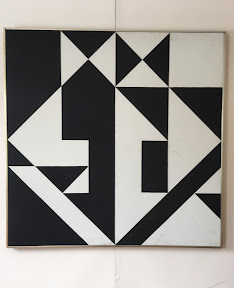
A few years ago I purchased a painting at auction that I hoped was by my old friend Leon Polk Smith. It was a medium large, grid based, black and white geometric painting the kind I was assigned as a freshman in art school signed simply Smith 70.


Smith's longtime partner Bob Jamieson soon enough threw water on my great find in the nicest possible way. Something about it being a little too busy and trying a little too hard for it too be Leon's. Inotherwords not nearly elegant enough.


I knew it was something though, and I was still convinced it was Leon's. An under bidder, great term, had, after all, tried to offer more for it to me after the auction. This was no freshman project.


Enter Richard Tuttle. My brief mentor, the young and reluctant guru of my youth who spoke in riddles and got inside my head in a way that pissed me off for decades. He had worked for Betty Parsons and was privy to her store house, her back room stacks of art magic by all the greats who had passed through her gallery on 57th Street in Manhattan. He had claimed one of those as his mentor, Ellsworth Kelly, Leon's successful rival for the crown of elegant hard edged abstraction, even though Leon in turn claimed that she liked him best.


So I was struck one day while trying to unlock the mystery of this painting I had bought, that of course there was another Smith. Could it be? And then I remembered a story I had read from Kiki Smith about Richard Tuttle hanging around her family's home when she was growing up. I imagined a young Tuttle sitting alone in the living room with maybe a big hairy family dog, being asked to hold something, or if he had seen Seton, or if he would like to stay for dinner. Anything to soak up the enigmatic genius of the prince of American monumental geometric sculpture, Tony Smith.


Sure enough, it was all right there. The code. The binary bonanza. The bisected squares whose resulting triangles turned black or white, and left or right, to tell their story.


This is the language of Tony Smith's giant sculpture of the late Sixties and early Seventies. Large black painted aluminum grid and bisected cube based sculptures dreamed together by turning this geometric element one way or the other to see which way it would go and what it would become. Together they moved like a flock of swallows and then suddenly and unexpectedly shifted and surprised you.


I had a friend whose family had a house in a shoreline Connecticut enclave where Smith, who was also architect, had built a home. Decades ago she drove me by the house. There was also a geometric sculpture, one of the cubes, outside. I knew I was supposed to be impressed. I was still young and not easily impressed and so I wasn't. Maybe one of the worst of many bad qualities.


But there was his cube. So strong. The ultimate riddle. Patient and wise. Inscrutable. Impenetrable. Infuriating.


And there I was today, parked in front of this painting. Almost lost in a trance, sometimes dozing, flickering on the edge of consciousness, and it happened, doors began slamming open and closed, dimensions shifted, transformation unfolded right before my eyes. Did I just see that? I shook my head. I googled Tony Smith images on my phone. Still in a daze I rifled through them. Sculptures of huge proportions changing before my eyes, with simple slight of hand, showing me one face, one being, and then another, like dragons doing a secret dance, only to disappear and still themselves in a pose to be invisible to passers by.


Addison Parks
Spring Hill


It is worth noting that this painting is probably by some other Smith, despite the similarities. Just a little kickstart for looking at a sculptor who does not get much love these days.

Monday, February 13, 2017

Valentine


Addison Parks, Valentine, 2014, oil on board, 6 x 8


A sweetness
Like honeysuckle
Circles and
Entwines
A place both earthly and divine
In me
From you
A place both earthly and like heaven
Where soft caress and warm breath can leaven
My senses skyward
A high that since the night we met
Has never let
Me down
Just a smile
Everyday
No frown
To delay
This joyous race to
The end.


Addison Parks
Spring Hill

Thursday, December 29, 2016

Younghee Choi Martin: Unconscious!


Younghee Choi Martin, 2008, Thunder of Spring, oil on linen,  74  x 101"


Younghee was in my sophomore painting class at RISD. I had just transferred from Skidmore. It was a very interesting class with a lot of really powerful and diverse painters. Just what I was looking for. And in a very interesting class of powerful and diverse painters, Younghee Choi Martin stood out. You might say that she was the one. I think everybody thought so. And in that really nice way that things sometimes happen, she didn't act like she was that person, she didn't act like she was the star.


Younghee Choi Martin, 2004, Fall of Troy, oil on linen,  61 x 80"


But as cut throat and competitive as RISD was in general and this class in particular, Younghee Choi Martin was the painter everyone was looking over their shoulder at, wondering what she was doing, how she was seeing and painting what they were all seeing and painting. The year was 1974, the place was the Bank Building's giant painting studio, and the teacher was Lorna Ritz.


Younghee Choi Martin, 1999, Violet Air, oil on linen,  23 x 26"


Everybody was good. Everybody brought something to the table. Even the people who seemed forced into the shade were good and offered a unique vision. But Ritz liked playing students against each other to get results. She liked playing favorites to get results. She was that kind of teacher. Lazy. Mean. But even though Younghee was probably the favorite of the favorites, she never acted like it, or even went along with it. She was completely interested in what everyone else was doing.


Younghee Choi Martin, 2012, Grief into Joy, oil on linen,  18 x 18"


The favorites were all women. A correction for a male dominated art world. Ritz made some of the toughest guys in the class cry. She was legend for it. I had the strange honor of being the only guy included in one of her weekly all women exhibits of the class's work that she would curate in the library. Otherwise she regularly insulted me with her squeaky little voice and smile. I say all this because it made Youngee's humility that much more striking.


Younghee Choi Martin, 2011, Here is the Meadow Where We Started, Small I,
oil on linen,  15 x 22"


I didn't know Younghee well, but she was always friendly, and a friend of friends. The little I had heard about her was that this very gifted painter had had a hard life. That she still had a hard life. That she lived in a crappy apartment in a crappy part of Providence, without heat. At least that is what I remember. She was way too skinny in that way that says undernourished. But undernourished or not, in the Bank Building, painting, she was a spirit possessed.


Younghee Choi Martin, 2007, Orestes' Revelation, oil on linen,  30 x 34"


We bumped into each other in New York occasionally years later, still a friend of friends, and she was still alive and painting. The same spirit possessed with a brush in her hand. Our mutual friend Carol Heft, herself a gifted painter from that Bank Building class, has always stayed close to Younghee. Today they show in adjacent galleries in New York City's Chelsea gallery district. The Blue Mountain and Bowery on 25th.


Younghee Choi Martin, 2007, Memory of Dawn, oil on linen,  9 x 12"


To say that Younghee's work is still the same sounds like a put down, except that she was always good. Anyone who knows me gets that I am free and easy with hyperbole, but also that I generally steer clear of comparisons, and comparative language. Bad, good, better, best. Younghee might be the quiet exception. Quiet, perhaps to her detriment. Quiet, definitely to her detriment if the objective is fame and fortune.


Younghee Choi Martin, 2012, Ascent, oil on linen,  36 x 45"


Younghee could probably paint the pants off of any painter out there dead or living and they would know it. The Resnicks and Pollocks of this world, no pants. I won't mention the living so as not to embarrass anyone, but we all know who we are.


Younghee Choi Martin, 2012, Here is the Meadow Where We Started,
 oil on linen,  74 x 112"


Unconscious is a word people use to compliment someone's work sometimes, especially athletes. That's Younghee Choi Martin. Unconscious! High praise.


Younghee Choi Martin, 2006, Arcadia, oil on linen,  47 x 54"


She paints classical themes. I am not sure why. I could guess. Excuse to make a painting. They read abstractly but they are figures in a setting, a landscape. Maybe she delights in the stories. Maybe she loves the masters. Maybe she likes the way figures like shapes interact in a space. But stroke for stroke she brings paint to life like the first creature that climbed out of the primordial ooze.


Younghee Choi Martin, 2012, Riverbanks, oil on linen,  81 x 80"


Why some dealer somewhere hasn't given her a parade I will never know. Why the Whitney hasn't called her number is beyond me. Younghee Choi Martin has always been something special.


Younghee Choi Martin, 2004, Thunder of Spring, oil on linen,  75 x 100"


Addison Parks
Artdeal Magazine
Spring Hill, December 2016


Younghee Choi Martin


Younghee Choi Martin, 2004, Nabi Gallery, New York


Younghee Choi Martin, 2012, Bowery Gallery

Thursday, December 22, 2016

I Call Myself Artist


Addison Parks, Ear, 2016, oil on linen, 14 x 11


Never mind that for years I preferred the more practical term of "painter." I bought into the idea that "artist," like "genius," was something you earned, bestowed upon you by others through merit.


Addison Parks, Lovey, 2016, oil on linen, 20 x 16


I can't remember not painting or drawing. They have been my life long companions, helping me through every phase of my life, every adventure, every change, of which there have been many, every joy, every heart break, every mountain climbed, every fall off said mountains.


Addison Parks, Syrian Kat, 2016, oil on linen, 14 x 11


Whenever I read about the Carl Andres of this world declaring an end to the "tradition" of painting and sculpture I just have to laugh and think that they obviously never knew about these things, never experienced them, never found themselves in them, never lost themselves in them, was never remade or reborn in them. They never got it. Easy to just say nanny nanny poo poo. For me it would be like declaring an end to love or sunlight.


Addison Parks, Landscape with Blue Sky, 1975, oil on board, 16 x 20"
collection of Bruce Helander


Now maybe I am like some Beatrix Potter or Emily Dickinson, more than content with the marriage of imagination and the blank page. A recluse with a box of paints or a pen.


Addison Parks, Three Ships, 1966, oil on board, 6 x 24"
painted on Via della Minerva, Rome


My first box of paints came to me from a mad Welshman my mother had had an affair with when we first moved to Rome. We were flying home to Ohio from a year and a half living on the island of Mykonos and wintering in Athens. I suppose my mother couldn't stand the idea of the options that lay ahead. She looked out the window as we were sitting on the runway in the Rome airport, said quick quick quick, grab your stuff, and we lived there over a five year period, and she for twenty. Until my children were born, Rome was my happiest memory.


Addison Parks, Brickabrok (2016); oil on linen, 16 x 20 inches


The Welshman, Handel Evans, was a brilliant artist and a joy for me and my sister. We made puppets together and drew and painted all the time. He taught me his artist secrets and I was his devoted apprentice. The year was around 1961-62, and JFK was still alive and beloved in Europe. Handel was not an abstractionist, the art which my mother championed(we had paintings by Kline and Resnick and de Stael to name a few), but his work was well informed by it along with automatism, cubism, and surrealism. It was very powerful and original and fully integrated, but at the same time open to inspiration from Bernini and all the juices that flowed from the breast of the beast that was Rome. Like Pollock and de Kooning he came to learn.


Addison Parks, Ali (2016); oil on linen, 16 x 20 inches


In fact we ended up on that street where they had had studios. Via Margutta. My mother had by then traded in Handel for a more handsome arm, a young tenor from Canada, and all that was left of my first mentor was a box of paints under the stairs that I imagined he had left for me. My first oil painting at the age of 8 was of our cat. I can smell those paints still, like a meal wafting from the kitchen, and feel the excitement and trepidation and miracle of this rich, sensuous, malleable substance that could bring a dry brittle white canvas to life.


Addison Parks, Banana Bush (2016); oil on linen, 16 x 20 inches


Until then Handel had only let me use pencil, and colored inks. Oil paint was for later. Like black shoes, which my mother would not allow. Boys wore brown. And grey flannel shorts. Never long pants. Rain or shine or snow or sleet I wore shorts. I also had a cough all winter long.


Addison Parks, Bending Birches (2016); oil on linen, 16 x 20 inches


Handel had taught me how to find the painting in the painting surface. How to prepare a wood panel with plaster, and in the barely perceptible patterns commingle memories, dreams, and observations, entwining them by scratching into the plaster and letting the inks flow.


2016, in progress


A few years later Gino Severini would recommend the same practice to me, except that he added sand to the fresh plaster to further enhance the patterns and texture.


Addison Parks, Angel Wings 2, oil on linen, 20 x 16"


These days I let a preliminary coat of paint on the canvas guide me in much the same way. Or sometimes I use the canvas as my palette until it sets a course.


Addison Parks, Angel Wings, oil on board, 8 x 10"


Then the conversation begins. I listen. I respond. I make a proclamation. I wait for an answer. Somewhere in the dance of all that, things find their way to the surface, they reveal themselves, and I am reborn.


Addison Parks
Spring Hill, December 2016