Last night I was captivated by an airing of a lecture by Richard Dawkins at a southern women's college on C-Span. After the inevitable "now what?" let-down of the elections, whose outcome was of course very pleasing, this was just the ticket. An English gentleman lecturing about the absurdity of God and God-beliefs in small town America. While he had an excellent audience that was academic, and by and large very supportive, he was NOT singing to the choir. We are at times a nation of church-going, God fearing, mindless lemmings. This was fascinating. What was amazing at that moment was how civil he was most of the time. What was also amazing was that the questions were not all ridiculous. It was a very good dialogue for television. Much better than all the recycled tripe on Hardball! It would make a GREAT television show! This is something people are REALLY curious about. What do they believe? Are there alternatives? What if you like some of the rituals, community elements, and even some of the people, but don't adhere to the beliefs for a second? I suspect that there are a lot of these people. There better be! There are also people that are excluded from those things because they don't believe.
Why am I writing about this? What does this have to do with art? First of all, plenty, and second of all, because I have a few questions of my own, thank you very much.
Richard Dawkins is a supporter of the Brights' Net movement. Brights are essentially Atheists. Bright is intended to be a positive term for Atheists along the lines of the term Gay, and what it did for the same-sex movement. And we are talking movement. A political force if you will. Why? Because religion is controlling the discourse, not only in this country, but around the world! So naturally I am right on board.
The Brights will tell you right up front that:
"Our nations, cultures, politics, genders, occupations, interests, and so on differ widely. However, we are generally "“in sync" with one another because we share a worldview that is free from supernatural and mystical elements. We are set apart in a broad sense from those who have worldviews that embrace such elements, whether entities such as deities, or forces, or both."
First of all I think it's great what they are doing. It is a big thing. It is a good thing. A very distant second thought is that I don't think you can have a movement that is defined by what it is not. Well, maybe you can, but it is reactionary in nature then, and at a distinct disadvantage when trying to hold it's own against the fanatics. On the other hand quibbling about that it is like standing in front of the Grand Canyon and arguing about the color of the shoe laces on your boots. Again, this is a big thing. A good thing. So although I have a problem with the "free from" thing figuring up front so prominently, it is a minor issue.
How does this figure into art? Art for art's sake. That says it all. I believe Brights' Net is merely "Life for life's sake." THAT says it all. Very positive. What art for art's sake meant was precisely the same thing in that "free from" was implicit. Art for art's sake paved the way for Abstraction, which was self-identical, about itself, of itself, etc. and I think that this is relevant to the discussion of being Bright. Abstraction IS the real. No illusion. Real color, real line, real paint, real form, real real. Bright is the same. Real. Reality. No illusions. No false references. Natural law. No pointing over there; but instead looking right here, right now, sober and clear eyed and yes, free from supernatural and mystical elements. It is a commitment to free-thinking; finding reasonable explanations for what we don't understand instead of inventing myths and relying on superstition to ease our pain and confusion.
This is a very positive thing. For so long now we've been trying to fix religion. Reform it. Create new ones. Those of us who rejected it altogether in favor of Life, life for life's sake, were disenfranchised, shouted down, alienated. Richard Dawkins is the kind of voice in the wilderness that David Hume was, the big difference being that Dawkins is out talking about it with people, people all over the world. HE is BRAVE. David Hume didn't have to remember too far back to when people were burned alive for being merely reasonable.
There is no fixing religion. We've tried that. People who want the sense of community, the comfort of rituals, the interaction, the sense of belonging, the sanctuary, need to seek a more reasonable solution. (Ironically religion involves a ridiculous amount of imagination--too much!) Reasonable imagination would do. Bright is a brilliant and imaginative alternative.
I've always felt very positive about art. Some people think it can be a religion. It is something better. It is a place that demands that we look and feel and think about the world around us, and then take that and celebrate it.Wartss and all. That we appreciate it! That we do it HARD! It locates us where we are, when we are, how we are and what we are. Even who and why we are. The path. The true path. The razor's edge. Accepting the challenge. Embracing the challenge. Keeping it real. Always learning. Always taking the hard fork in the road. True. No mystical bits. Just LIFE. Sounds pretty Bright to me.
That said, what does it mean? That said, what someone wants to believe or not believe is their business. No exceptions. So getting all excited about a reasonable world is just as absurd as believing in the Easter Bunny. Life is not reasonable. Reasonable, like every other ideal is, up to us. Like justice or charity or civility. How many times have I been wrong trying to right a wrong. Makes me shudder to think. My shoulders bunch up and a wave of "sorry" comes over me. Two wrongs. Wrong every time. I already regret ragging on religion.
It is hard to treat love reasonably. I've seen it done, and the results were anything but reasonable. I'm not even sure it's worth trying to accomplish. Reasonable is not warm. Reasonable is not comfortable. Not supposed to be. But don't we need comfort. Am I going to deny the comfort religion, with all its supernatural and mystical elements, can bring to the lonely, the poor, the lost, the confused, the downtrodden, the betrayed, the forgotten, the abandoned, and misunderstood? After all, who knows? It is very hard to practice the reasonable, even for those who preach it, just like it is hard for those who preach virtue. For every priest or evangelical who fail themselves and the ones they were meant to love and protect, there are the reasonable ones who go down in flames obsessing over some crush. Something they can't control. I've seen it. I've seen Oxford Dons taken down by aninfatuationn that was anything but reasonable. So so much for the church of reason. Fact is, we're on our own, and where ever we find sanctuary, well, any port in a storm. Good night and good luck!
Monday, November 13, 2006


Wednesday, October 18, 2006
Express your YES!
Express your yes! This means having a positive attitude about what you do, what you believe, what you support, what you dream. It does not mean being defensive about these things. That's a no. Zidane. Don't Zidane anyone or yourself for what you do, believe, support, dream. The headbutt is not the answer. Yes is the answer. Don't let a jerk make a jerk out of you. Yes is the answer. Is it hard? You bet. It is the only way to go? Absolutely.
You see it with those in the extreme everywhere. They explode or implode. Yes is the answer. If you are an artist, give yourself the yes you need and leave the no behind. When you do the no, the rebel, you join yourself at the hip to the thing you are trying to get away from. Yes keeps you free. Are there consequences? Yes. Are they worth the price? Absolutely. When you have that yes you are always ready to go your own way. No is a negative force the way defense is a negative force. Who can tell who is the good guy and who is the bad guy in a fight. No one. It stinks. Peace. Yes. When you get involved with fighting war, you are Zidane. You've stepped in shit. You become part of the shit. For what it's worth, as an artist, you also spare yourself the incessant need to put other artists down to lift yourself up, which is a defensive and negative action. You will free yourself from that game, the need to opine, the need to be strident, and the yes will restore your energy in a positive and creative direction, so that you can be your true self, true TO yourself, and your work, and others!
I did not rebel against school when I was a boy. I just didn't give it power over me because I had too many other things that were important to me, that I wanted to do, that I had a yes for. Did I suffer the consequences as far as the school was concerned. Of course. I didn't care. I had a great life. School sucked. I gave it no more than was required by law. Of course school doesn't have to suck, but there is no getting around that it is a breeding ground for bullies, children AND adults(teachers, administrators, custodians, etc.). All of this is hard. The only way to flourish, to grow, to be happy, to do something truly good, is to express your yes!
You see it with those in the extreme everywhere. They explode or implode. Yes is the answer. If you are an artist, give yourself the yes you need and leave the no behind. When you do the no, the rebel, you join yourself at the hip to the thing you are trying to get away from. Yes keeps you free. Are there consequences? Yes. Are they worth the price? Absolutely. When you have that yes you are always ready to go your own way. No is a negative force the way defense is a negative force. Who can tell who is the good guy and who is the bad guy in a fight. No one. It stinks. Peace. Yes. When you get involved with fighting war, you are Zidane. You've stepped in shit. You become part of the shit. For what it's worth, as an artist, you also spare yourself the incessant need to put other artists down to lift yourself up, which is a defensive and negative action. You will free yourself from that game, the need to opine, the need to be strident, and the yes will restore your energy in a positive and creative direction, so that you can be your true self, true TO yourself, and your work, and others!
I did not rebel against school when I was a boy. I just didn't give it power over me because I had too many other things that were important to me, that I wanted to do, that I had a yes for. Did I suffer the consequences as far as the school was concerned. Of course. I didn't care. I had a great life. School sucked. I gave it no more than was required by law. Of course school doesn't have to suck, but there is no getting around that it is a breeding ground for bullies, children AND adults(teachers, administrators, custodians, etc.). All of this is hard. The only way to flourish, to grow, to be happy, to do something truly good, is to express your yes!
Friday, October 06, 2006
On Paper
You know the sports aphorism that if games could be won on paper then there would be no point in playing them. The truth is that not only do they not get won on paper, but that this is the whole point of playing the game. As much as we try to achieve things on paper, and there are people dedicated to figuring out how to make that happen, it just doesn't make any difference. If you can't factor in everything( you can't), and all it takes is one unfactored event, well... then the best laid plans of mice and men...
Does this happen in the art world? ALL THE TIME! Does it frustrate people? YOU BET!
Do you get it? Well, you see it with designers, architects, engineers, etc, all the time. They conceive it on paper and then in REAL life: it sucks. EVERY TIME! About thirty years ago someone in the art world coined the phrase: site-specific(ten years before that it was just called "going with the flow"). I don't know who. Who are you? It was like identifying gravity. There all along, but someone gave it a name. We're good at that. Anyway, there you have it: site-specific. What does that mean?
Well, in the art world it was limited. Limited to a specific site( a gallery, a museum, a landscape, a city space, etc.--it spawned what we now know of as Installation Art). It meant that all the decisions that went into making something happen, into making a work, a work of "art," were made in that particular time and space, in the place where it would exist--as much as humanly possible. Unfortunately, as a result of this limitation, in the end it was naturally limited to this specific idea and experience. But the real meaning is much larger. When you create something within the space(and time!) it is meant for, rather than on a drawing board somewhere, you feel the space, you rely on feeling the space, and you respond to everything about it. You don't just see it in your mind's eye, you feel the energy around and between things, below and above things(this means light and temperature, and sound, and color and texture, as well as history and function and so much more), and you not only surrender to it, you embrace it, you honor it, you serve it, you celebrate it( all the feng shui rules and recipes can't cover it--you have to BE there)! And that is huge! A huge difference, and huge distinction, a huge chasm between the two. It makes all the difference in the world.
This figuring stuff out on paper plays out everywhere. On Wall Street, in the Pentagon, in Fashion, and as I said, in Sports--and in the minds of people young and old. How many times did I go out with someone who was great on paper and a dud in real experience. MY FAULT. No one else's. They weren't really a dud, just not the person for me. I never listened to my feelings. I remember that Richard Tuttle tried to explain this to me but was ill-equipped because he hadn't quite put it together. He put it in terms of doing the best thing instead of the right thing, the right thing being, I guess, right on paper. The other thing, the best thing, had to do with this larger idea of site-specific. It is not just being "in the moment." Even that is too limited.
This is larger. The sort of stuff when you put time and space together. You can see a long way, and a long way AROUND. Shades of Vonnegut. Is there something to be said for paper? Maybe, but I can't really say one way or the other. What it reminds me of is when I was moonlighting(Addison) as a young art critic. People would tell me what their work was about "on paper" and all I wanted to say was "Huh?" And then when I asked them what was really going on they would explode from inside with all this emotional stuff. None of this "juxtaposition" crap. The same was true when they showed me their sketches. All I could think was: wow! this is where it really happened--the finished piece is just an empty shell. As a result, I tend not to do sketches, ever really. I try to make it all happen it the work. It either happens right there or it doesn't. Have I done work I liked from sketches. Yes, but mostly because something ELSE happened.
I know this is a little different, but it is connected.
I saw a card for a show called SHOCK. Hello? Talk about setting yourself up for a fall! You've given it all away on so many levels, surprise being a critical one. It is like telling someone you're going to hide behind a door and say boo! SCARY! Also connected.
I heard yet another artist ragging about how all the work(except THEIRS!) really sucks. Because someone else is showing or selling or getting written up-- and not them. It is not supposed to be this way: ON PAPER!
Does this happen in the art world? ALL THE TIME! Does it frustrate people? YOU BET!
Do you get it? Well, you see it with designers, architects, engineers, etc, all the time. They conceive it on paper and then in REAL life: it sucks. EVERY TIME! About thirty years ago someone in the art world coined the phrase: site-specific(ten years before that it was just called "going with the flow"). I don't know who. Who are you? It was like identifying gravity. There all along, but someone gave it a name. We're good at that. Anyway, there you have it: site-specific. What does that mean?
Well, in the art world it was limited. Limited to a specific site( a gallery, a museum, a landscape, a city space, etc.--it spawned what we now know of as Installation Art). It meant that all the decisions that went into making something happen, into making a work, a work of "art," were made in that particular time and space, in the place where it would exist--as much as humanly possible. Unfortunately, as a result of this limitation, in the end it was naturally limited to this specific idea and experience. But the real meaning is much larger. When you create something within the space(and time!) it is meant for, rather than on a drawing board somewhere, you feel the space, you rely on feeling the space, and you respond to everything about it. You don't just see it in your mind's eye, you feel the energy around and between things, below and above things(this means light and temperature, and sound, and color and texture, as well as history and function and so much more), and you not only surrender to it, you embrace it, you honor it, you serve it, you celebrate it( all the feng shui rules and recipes can't cover it--you have to BE there)! And that is huge! A huge difference, and huge distinction, a huge chasm between the two. It makes all the difference in the world.
This figuring stuff out on paper plays out everywhere. On Wall Street, in the Pentagon, in Fashion, and as I said, in Sports--and in the minds of people young and old. How many times did I go out with someone who was great on paper and a dud in real experience. MY FAULT. No one else's. They weren't really a dud, just not the person for me. I never listened to my feelings. I remember that Richard Tuttle tried to explain this to me but was ill-equipped because he hadn't quite put it together. He put it in terms of doing the best thing instead of the right thing, the right thing being, I guess, right on paper. The other thing, the best thing, had to do with this larger idea of site-specific. It is not just being "in the moment." Even that is too limited.
This is larger. The sort of stuff when you put time and space together. You can see a long way, and a long way AROUND. Shades of Vonnegut. Is there something to be said for paper? Maybe, but I can't really say one way or the other. What it reminds me of is when I was moonlighting(Addison) as a young art critic. People would tell me what their work was about "on paper" and all I wanted to say was "Huh?" And then when I asked them what was really going on they would explode from inside with all this emotional stuff. None of this "juxtaposition" crap. The same was true when they showed me their sketches. All I could think was: wow! this is where it really happened--the finished piece is just an empty shell. As a result, I tend not to do sketches, ever really. I try to make it all happen it the work. It either happens right there or it doesn't. Have I done work I liked from sketches. Yes, but mostly because something ELSE happened.
I know this is a little different, but it is connected.
I saw a card for a show called SHOCK. Hello? Talk about setting yourself up for a fall! You've given it all away on so many levels, surprise being a critical one. It is like telling someone you're going to hide behind a door and say boo! SCARY! Also connected.
I heard yet another artist ragging about how all the work(except THEIRS!) really sucks. Because someone else is showing or selling or getting written up-- and not them. It is not supposed to be this way: ON PAPER!
Thursday, September 28, 2006
Guilty As Charged!
Politicians forget that they are pubic servants. Service people forget that they are there to help. Teachers forget that they are charged with the care of young people's dreams(as a father of four I am only TOO aware of this). The power goes to their heads. They like being in charge; not being charged with a responsibility. The destruction these people cause can be devastating.
I had mostly lousy teachers(and I was a lousy student, thank goodness, because we moved a lot and I fell through the cracks, and to a large extent remained unschooled). We were stuck in school; they were stuck in jobs. There were times that I taught because I needed a job. Were there times when I made mistakes as a teacher. ABSOLUTELY. Do I regret them? ABSOLUTELY. Did I overstep my bounds? ABSOLUTELY. Guilty as charged.
I had mostly lousy teachers(and I was a lousy student, thank goodness, because we moved a lot and I fell through the cracks, and to a large extent remained unschooled). We were stuck in school; they were stuck in jobs. There were times that I taught because I needed a job. Were there times when I made mistakes as a teacher. ABSOLUTELY. Do I regret them? ABSOLUTELY. Did I overstep my bounds? ABSOLUTELY. Guilty as charged.
Tuesday, September 19, 2006
Get it going on!
I have this idea that training is antithetical to expression. I can't quite express it to my satisfaction, but I see proof of it all the time. I see people who are untrained and they get it going on. I see people who are trained and the whole thing is dead for them. If there are exceptions, and that is why we train people, then I don't get it. Is it worth it to achieve exceptions? The exceptional? Is that what that means. Training is backward looking by definition. It is based on time tested and honored standards and traditions and successes. But time moves. That was then, this is now!
The only reason I bring this up again is that I have just seen it happen, again, and I have experienced both sides of it for myself. As a painter I have been over trained. Over informed. Recently I started making sculpture. It is so fresh. I don't know the rules. There are no voices in my head. I feel the way I did before I trained as a painter. Free. It feeds over into my painting, too, thank heavens. So many people, good and bad, think you shouldn't be allowed to be an artist without permission, without training, without the blessing of the institution. People shouldn't be allowed to be free!
I look in Art Forum and as weird as some things might be in there, I feel like I have seen them all a thousand times before, and it just looks like garbage. Stale, weird, self-absorbed dramatics. I've seen some things recently out in the world by some people who weren't trained, things I have never seen before, and I have to say, I feel envious that they can just do stuff and not know either what they are doing or that they aren't supposed to be able to do it. I've spent a lot of my life defying the "you can't do that" just because I wanted to do something and didn't care one way of the other about the powers that be or the rules. But it wears you down. I just had something I wanted to do. Maybe it was just something else. It wasn't a reaction or rebellion. I just had something I wanted to do. My ex-mother-in-law once said to me that I could do anything I wanted as long as it was "trad." I was confused. I thought she meant something like plaid. It was like saying you can paint your house any color you like as long as it is white.
Someone asked my daughter the other day if she was taking piano lessons. I cringed. My theory is, spend time with a piano. Get to know it. Let it know you. Then you can play the piano. I don't know one person who took piano lessons who actually plays, or likes playing the piano. Plus, why is it that we look the other way on this one: you play someone else's music and not your own. What is that all about? Even painting and writing you aren't expected to paint or write someone else's work. What is it with music that we swallow this kind of training and mind-set? Who is in charge? There really needs to be a revolution there. Of course there was. It was called jazz, or folk, or rock, or rap.
This person who asked my daughter if she is taking piano lessons meant well. She is finally getting to take "advanced" painting at Smith. But when the class started they didn't start painting. They started having crits before they started painting. The "preemptive" crit. Get it in before the student even has the audacity to think they might have an idea about who or what they are and what they might paint. Get to them before they naively think that they might just paint. That is evil.
Who survives this kind of tyranny? John Lennon didn't survive. John Doe didn't either. We need other people in charge. I've always felt sure that the last person to lead should be the one who wants to. We need benevolence in all things.
The only reason I bring this up again is that I have just seen it happen, again, and I have experienced both sides of it for myself. As a painter I have been over trained. Over informed. Recently I started making sculpture. It is so fresh. I don't know the rules. There are no voices in my head. I feel the way I did before I trained as a painter. Free. It feeds over into my painting, too, thank heavens. So many people, good and bad, think you shouldn't be allowed to be an artist without permission, without training, without the blessing of the institution. People shouldn't be allowed to be free!
I look in Art Forum and as weird as some things might be in there, I feel like I have seen them all a thousand times before, and it just looks like garbage. Stale, weird, self-absorbed dramatics. I've seen some things recently out in the world by some people who weren't trained, things I have never seen before, and I have to say, I feel envious that they can just do stuff and not know either what they are doing or that they aren't supposed to be able to do it. I've spent a lot of my life defying the "you can't do that" just because I wanted to do something and didn't care one way of the other about the powers that be or the rules. But it wears you down. I just had something I wanted to do. Maybe it was just something else. It wasn't a reaction or rebellion. I just had something I wanted to do. My ex-mother-in-law once said to me that I could do anything I wanted as long as it was "trad." I was confused. I thought she meant something like plaid. It was like saying you can paint your house any color you like as long as it is white.
Someone asked my daughter the other day if she was taking piano lessons. I cringed. My theory is, spend time with a piano. Get to know it. Let it know you. Then you can play the piano. I don't know one person who took piano lessons who actually plays, or likes playing the piano. Plus, why is it that we look the other way on this one: you play someone else's music and not your own. What is that all about? Even painting and writing you aren't expected to paint or write someone else's work. What is it with music that we swallow this kind of training and mind-set? Who is in charge? There really needs to be a revolution there. Of course there was. It was called jazz, or folk, or rock, or rap.
This person who asked my daughter if she is taking piano lessons meant well. She is finally getting to take "advanced" painting at Smith. But when the class started they didn't start painting. They started having crits before they started painting. The "preemptive" crit. Get it in before the student even has the audacity to think they might have an idea about who or what they are and what they might paint. Get to them before they naively think that they might just paint. That is evil.
Who survives this kind of tyranny? John Lennon didn't survive. John Doe didn't either. We need other people in charge. I've always felt sure that the last person to lead should be the one who wants to. We need benevolence in all things.
Wednesday, May 10, 2006
Love and Art; Power and Money
If you're going to do anything sweet in this world, of course, you're on your own. It doesn't register on any scale. As they say, money talks and everybody listens. The way things are. No point in being unhappy about it. You have to like it. It does not mean however, that there aren't other ways to go. And doing something sweet, for the love of it, well, that has it's own reward, and you had better see them for what they are.
Tuesday, April 25, 2006
You Get It After You're Dead!

It's been a while, but this is a good one. I have a friend who came into a little money, or so they thought. Turns out, when they had the nerve to ask the family head about it, this is what they got. "You get it after you're dead." And they were, forgive me, dead serious. Still, always good for a laugh!
Now I haven't figured that one out yet, and I'm not sure I ever will, but the other day I figured one like it out quite by accident. I think someone was lamenting the whole "artists never make it until after they are dead" thing. I immediately, without thinking, responded that this was the way it was supposed to be. Then I realized that I wasn't being ironic; I was right.
I've written before about the whole "you can lead a horse to water but can't make it drink" thing. That was a hard one for me because I was a teacher. It was my job to make the horse drink, or so I thought. Then I realized that it wasn't supposed to be the challenge I had taken it for, and that you couldn't do it. That just depressed and frustrated me. I was so sure that if I couldn't do it I was a failure. Clueless. Forgive me. Then one day I got it. You're just supposed to lead the horse to water. Drinking has to be the horse's idea. You not only have to accept this one, you have to like it. And of course this goes for the rest of life: you not only have to accept the truth, you have to like it. Then again, you don't have to if you don't want to. Drink or don't, it's up to you.
But this is the deal with artist's always getting famous after they die. It's a good thing, believe it or not. We didn't hear it all our lives for nothing. It is the way it is, and the way it is supposed to be. The exceptions are so few, much fewer than we think. There are more aspiring artists that get off the bus in New York on just one day than there are famous artists. It's a fact. Artist's are not supposed to be famous in their lifetime. It ruins them. History is littered with artists who were famous in their day and we have no idea of who they are. It is almost impossible to be famous and be an artist. It is putting the cart before the horse. There's that horse again.
Sunday, March 26, 2006
The Fork in the Road; The Razor's Edge
I ran into a couple of artists yesterday. One in the morning, the other in the afternoon. Same thing. Frustrated about their careers. Leon Polk Smith liked to say that if he had to he would pay money to be an artist. The fact is, every artist does pay. They invest money in studio space and supplies that they will never get back.
Stay close to the source. You find God in nature and in life, not in churches. The same is true of art. You have to stay close to the light. Every second an artist spends worrying or obsessing about their career the farther they get from the light. The world is filled with temptations to take the wrong fork at every turn. We compare, we score, we want more. It may be natural, but it's the wrong fork. It is simple math. You do the work. Without the work you have nothing. With the work you have everything that matters. The rest is crap, and it lures us with promises that are static illusions. Visions of grandeur, visions of glory. False evidence that we matter somehow.
Those two artists I ran into are gifted. Art is a gift. For giving. I just wanted to slap them. SHUDDUP! STOPPIT! Quit wasting your time and mine talking about stupid shit. If they could only hear themselves. Sure, they do another kind of math. The exposure game. The more exposure they get, the more chance they have of making it. Never happen. You can't force life. All you get is resistance. Be grateful for what you have if indeed you have some time during the day when you can do the work.
Sharing your work is a blessing as well. It is part of the process. Find ways to do it, but don't be pushy. Let the horse drink when it feels like it, all you can do is get it there. Better to make sure the water is good, clean, pure, drinkable, worth drinking and so on.
That's the deal. The razor's edge. It is not only sharp for a reason, we are supposed to keep it sharp. Every minute. And every choice we are faced with, every dilemma, every spot we find ourselves in, we are challenged to do the right thing, make the right turn, make the right choice, by ourselves, the best we can, with the best tools we have, and our best judgment, and our biggest heart.
Stay close to the source. You find God in nature and in life, not in churches. The same is true of art. You have to stay close to the light. Every second an artist spends worrying or obsessing about their career the farther they get from the light. The world is filled with temptations to take the wrong fork at every turn. We compare, we score, we want more. It may be natural, but it's the wrong fork. It is simple math. You do the work. Without the work you have nothing. With the work you have everything that matters. The rest is crap, and it lures us with promises that are static illusions. Visions of grandeur, visions of glory. False evidence that we matter somehow.
Those two artists I ran into are gifted. Art is a gift. For giving. I just wanted to slap them. SHUDDUP! STOPPIT! Quit wasting your time and mine talking about stupid shit. If they could only hear themselves. Sure, they do another kind of math. The exposure game. The more exposure they get, the more chance they have of making it. Never happen. You can't force life. All you get is resistance. Be grateful for what you have if indeed you have some time during the day when you can do the work.
Sharing your work is a blessing as well. It is part of the process. Find ways to do it, but don't be pushy. Let the horse drink when it feels like it, all you can do is get it there. Better to make sure the water is good, clean, pure, drinkable, worth drinking and so on.
That's the deal. The razor's edge. It is not only sharp for a reason, we are supposed to keep it sharp. Every minute. And every choice we are faced with, every dilemma, every spot we find ourselves in, we are challenged to do the right thing, make the right turn, make the right choice, by ourselves, the best we can, with the best tools we have, and our best judgment, and our biggest heart.
Thursday, March 23, 2006
NEW AGE (of) AGENDA--THE HUMP!
The information age is over. We got the information and it is us. Too much info. Now we must face the new age. The Age of Agenda. Machiavelli would be horrified, ironically. There is such a thing as too much of even a good thing.
Where does this put us? The Age of Agenda means everyone has an angle. Not to be confused with the Age of Enlightenment, when everyone had an angel whether they liked it or not. Agenda is by definition secret. It is redundant to identify it as such. Some are just more or less secret than others. Gone is the Age of Innocence. This is the opposite age. On the other side of the wheel.
Yes, we could call it the Age of Politics. Same thing. Everyone has a blog. Everyone has an agenda. Nothing, NOTHING, is what it seems. 1984, but just twenty years too late. The Age of Paranoia? That too. Topsy-turvy. I can't wait for the movie about two gay men who cheat on each other and have secret lives as married men with children and are too ashamed to admit to it. Won't that be fun. Maybe I should contact an agent.
Cheating. That is what Agenda is about. One thing out front and another in back. The new beast with two backs. Cheating on oneself and everyone else. It is everywhere. We celebrate it. It's like gravity. Been there all along, but now everybody's doing it. I love the one about the pretty teacher having sex with one of her students.
WOW! That poor 14 year old boy. He's only the hero and envy of every adolescent boy past and present. And they are calling him the victim! We are talking about a thousand over-lapping agenda and no one can see the forest for the trees! Are the comics having a field day? Fox News and every other station is wringing their hands over this one. The only bad news here is that this kid's paradise on earth has turned to shit. For that I am sorry. The end of innocence is not what they were doing together but what everyone else has made of it.
Are our leaders at least partly to blame. Absolutely. Especially the bushy one we have now. I normally identify the agenda thing as the hump. You know, someone's trying to hump you. Everyone is trying to hump everyone these days, and I'm not talking about that teacher and her student. I'm talking about that hump that is about domination. It's like the Republican Agenda. Is there anyone these guys aren't trying to hump? The public, the environment, the animal kingdom, the world, God!
This is the Year of the Dog. It is kicking off the Age of THE HUMP, appropriately enough. Although I think it really started in the Year of the Rooster. So what can you do? You watch out! You lie down with dogs you get up with flees, and you probably got humped in the process. Don't close your eyes and hope it will go away. This is the gauntlet. Keeping your eyes open is the only chance you have. See things plainly. It is not a question of whether someone has an agenda, it is just a question of what it is and what it is going to cost you. The next question is, can you pay the piper? The bushy one.
Where does this put us? The Age of Agenda means everyone has an angle. Not to be confused with the Age of Enlightenment, when everyone had an angel whether they liked it or not. Agenda is by definition secret. It is redundant to identify it as such. Some are just more or less secret than others. Gone is the Age of Innocence. This is the opposite age. On the other side of the wheel.
Yes, we could call it the Age of Politics. Same thing. Everyone has a blog. Everyone has an agenda. Nothing, NOTHING, is what it seems. 1984, but just twenty years too late. The Age of Paranoia? That too. Topsy-turvy. I can't wait for the movie about two gay men who cheat on each other and have secret lives as married men with children and are too ashamed to admit to it. Won't that be fun. Maybe I should contact an agent.
Cheating. That is what Agenda is about. One thing out front and another in back. The new beast with two backs. Cheating on oneself and everyone else. It is everywhere. We celebrate it. It's like gravity. Been there all along, but now everybody's doing it. I love the one about the pretty teacher having sex with one of her students.
WOW! That poor 14 year old boy. He's only the hero and envy of every adolescent boy past and present. And they are calling him the victim! We are talking about a thousand over-lapping agenda and no one can see the forest for the trees! Are the comics having a field day? Fox News and every other station is wringing their hands over this one. The only bad news here is that this kid's paradise on earth has turned to shit. For that I am sorry. The end of innocence is not what they were doing together but what everyone else has made of it.
Are our leaders at least partly to blame. Absolutely. Especially the bushy one we have now. I normally identify the agenda thing as the hump. You know, someone's trying to hump you. Everyone is trying to hump everyone these days, and I'm not talking about that teacher and her student. I'm talking about that hump that is about domination. It's like the Republican Agenda. Is there anyone these guys aren't trying to hump? The public, the environment, the animal kingdom, the world, God!
This is the Year of the Dog. It is kicking off the Age of THE HUMP, appropriately enough. Although I think it really started in the Year of the Rooster. So what can you do? You watch out! You lie down with dogs you get up with flees, and you probably got humped in the process. Don't close your eyes and hope it will go away. This is the gauntlet. Keeping your eyes open is the only chance you have. See things plainly. It is not a question of whether someone has an agenda, it is just a question of what it is and what it is going to cost you. The next question is, can you pay the piper? The bushy one.
Tuesday, March 14, 2006
NEOAB: Settled Abstraction
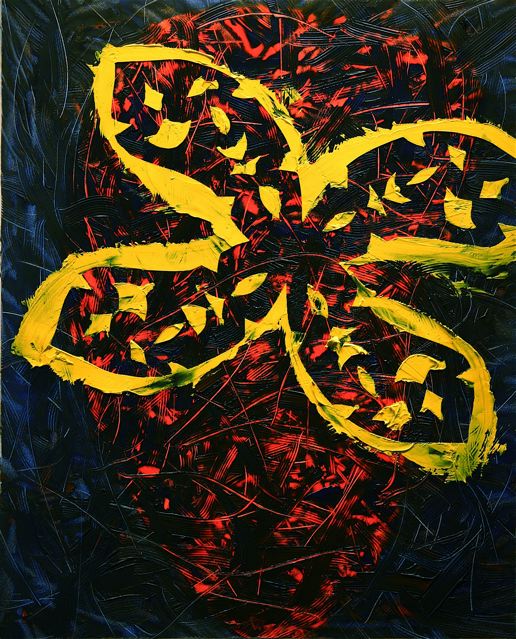
Before getting into the abstraction of the last twenty-five years, NEOAB, or neoabstraction, I would like to rant a little about another one of those negative ideas that get passed down unchecked, along the line that having a mind of your own or doing what you feel like are bad things. IMPRESSIONABLE. You know, how very impressionable he or she is, and how sad. Like this is a bad thing. That a person is moved by something or someone. Too sensitive. Too willing to listen. To consider trying something different, outside one's normal sphere of experience. It falls in the same camp as INFLUENCED. These are in direct conflict with the other two I just mentioned. If you have a mind of your own and do what you feel like, you are probably less impressionable and less likely to be influenced. Nonetheless, the idea that one could or would be influenced by forces outside oneself is not even worth discussing. We are nothing if not a lump of clay shaped by the world around us. But the idea that being unimpressionable would be considered a virtue is mind-boggling. That being easily impressed is a sign of bad character, that being influenced is a sign of weakness or perhaps a lack of character. The real question should be about which forces we allow to make an impression on us, and whether we are influenced by positive or negative energy.
One of the absolute worst things one can say about an artist is that they are heavily influenced. It is downright mean and practically indefensible. There is not an artist alive who has not been heavily influenced. The greatest artists were probably the most influenced. I just heard a story about the great Miles Davis, whose wife turned him on to rock and roll and Hendrix, and how it changed his life and his music. De kooning, Pollock, David Smith, Rauschenberg and everyone else, were influenced by Picasso, who made no secret of his influences and took it a step further by acknowledging that they were self-conscious influences, that he didn't borrow, he stole. Nevertheless, the worst thing you can still say about an artist is that they are influenced, period.
Consider the people in this world upon whom nothing makes an impression. The unimpressionable. The unmovable. By anything, especially the unprescribed, the unique. Things like children, nature, animals, art, music, literature, etc. Two things: first, what a shame; second, STOP making a virtue of the affliction.
Because if you are going to get anything out of this life you must allow yourself to be touched. The hope is in nature, in love, and in art. Let them make an impression.
Now on to NEOAB.
The very first Modern abstractionists were an absolute lot. Malevich. Mondrian. There were hard line, hard edge for a reason. They were trying to be clear about a new language. They were starting out with building blocks. Lego. The work had a graphic quality because the language came from a graphic place. The inspiration which shaped their images came from places like design and topography. They were not interested in the wilder or even more nuanced side of the language because it served no purpose. Rational clarity was imperative if this new language was to survive. It was no different than the kind of rigid severity required by the Pilgrims to survive their first few winters in the New World. You don't take any chances.
The abstract expressionist began by literally breaking down the hard line of such clarity in favor of exploring a more irrational, personal, emotional, poetic, gestural and fluid expression. They were influenced by impressionism, collage, calligraphy, and the can of worms that was opened by the world of psychology. They wanted to go down that rabbit hole and see what they could find. Dreams, the unconscious, the emotions, these were the stuff of the first generation of Abstract Expressionism, and they crossed the line. If you want an almost instructional example of this, look at the early work of De kooning. Everyone talks about the dissolve of the figure/ground relationship in these works, but one could more easily make a case for the break down of rational abstraction. De kooning would find an edge, cross it, find it again, cross it, again and again. He would do it until he had broken it down as much as he could and still have a painting/composition/picture.
NEOAB is not another generation of abstractionists exploring the language. That is over. NEOAB is the first and following generations of artists who accept abstraction as settled law. Indeed, if the abstract expressionists were frontiersman, NEOAB are the settlers who are building a life on ground those artists before them broke. Is there any virtue in being one of these settlers? Probably not. Virtue doesn't enter into it. NEOAB are not heroes like the original abstractionists. Those guys were giants, no question about it. I would never question that or try to diminish what they accomplished. Never. I have only respect and awe for them. Those of us who follow behind them have a different set of challenges, like keeping the curiosity, the wondering of it moving. It is NOT about refinement. It is instead about doing what it takes to expand. In some ways it could be considered a significant challenge. Like the war in Iraq, it is a question of winning the peace. It is also not about preserving abstraction. While we don't want to lose it, that is a job for historians, not artists. No, it is literally about settling it. Reinventing and reinvigorating it. Bringing new meaning to the language, new testimonials, new visions, new poetry. More than keeping it alive, bringing it new life. It is an evolution. Abstraction is evolving and will keep evolving.
Who are some of these artists? Joan Snyder. Bill Jensen. Jonathan Lasker. Jennifer Reeves. Thomas Nozkowski. Elizabeth Murray. Howard Hodgkins. Jessica Stockholder. Porfirio DiDonna. Richard Tuttle. Have they been around? Yes. Have they been doing this for a while? Yes. Is it settled abstraction. Yes. Is it good. Yes.
So what's the point? Dead End? Beating a dead horse. Scratching the same ground? No. Scratching the surface is more like it. Each of these artists brings their own vision to the language, like jazz, or even english. Since abstraction is indeed evolving, these artists bring that vision to the larger collective that is abstraction. Define abstraction. Well, that's another blog.
Subscribe to:
Posts (Atom)